

Why I’m Building Assets Instead of Chasing Income
For a long time, I believed that the solution to most problems was simple: earn more. More clients, more projects, more income. It felt like the most direct way to improve my life.
And to some extent, it worked.
As income increases, your options expand. You gain flexibility, you reduce stress, and you create room to move. But over time, I started to see a limitation that income alone could not solve.
No matter how much I earned, the structure remained the same. The income depended on my ability to keep working. If I stopped, it stopped. That dependency doesn’t disappear. It only scales.
That realization is what pushed me to rethink how I approach work, money, and long-term stability.
The Limitation of Income
Income is necessary. There’s no way around it. It’s the starting point of everything. But it has a built-in constraint that most people ignore.
Income is tied to three things:
- your time
- your effort
- your presence
Even when you improve your skills or increase your rates, those dependencies remain. You might earn more per hour, but you are still trading something to get it.
This creates a system where your output must be continuously maintained. You are not just earning, you are sustaining.
That works in the short term. It allows you to move forward, to build momentum, and to create opportunities. But in the long term, it creates pressure. It means that stability depends on your ability to keep performing.
That’s not the kind of structure I want to rely on.
The Pipeline Story
There’s a simple story that helped clarify this for me.
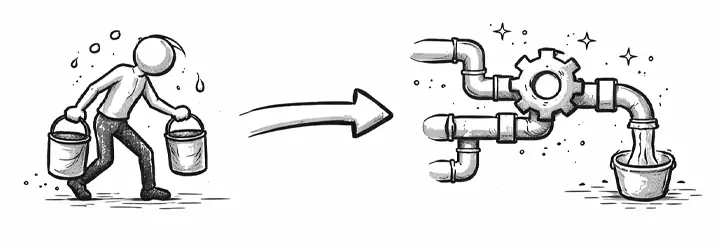
Two people, Pablo and Pedro, were tasked with bringing water from the top of a mountain down to their village. Pablo was strong, so he carried two buckets at a time. Pedro wasn’t as strong and could only carry one.
At the beginning, Pablo earned more. He worked faster, carried more water, and delivered more value in the short term.
Pedro took a different approach. Instead of focusing entirely on carrying water, he started building a pipeline from the top of the mountain to the village.
While Pablo continued to work every day, Pedro spent his time building something that had no immediate return.
Then one day, Pablo got sick.
He couldn’t carry water. He couldn’t work. And because of that, he couldn’t earn.
Pedro kept building.
Eventually, the pipeline was completed, and water began to flow continuously without him needing to carry it himself.
What the Story Actually Represents
The story is simple, but the structure behind it is important.
Pablo represents income.
- consistent effort
- immediate reward
- complete dependency on ability to work
Pedro represents assets.
- delayed reward
- upfront effort
- reduced dependency over time
Most people stay in Pablo’s position. Not because it’s better, but because it’s clearer. You work, you get paid. The feedback is immediate.
Pedro’s path is less obvious. You work, and nothing happens at first. There is no clear signal that what you are doing will pay off. That uncertainty is what makes it difficult.
The Shift I’m Making
At some point, I stopped asking how I could earn more and started asking what I could build that would continue to produce even when I am not actively working.
That’s the shift.
From output to structure.
From effort to systems.
From short-term reward to long-term function.
This doesn’t mean income is irrelevant. It still matters. It funds everything. It allows you to build.
But it is no longer the end goal. It becomes a tool used to create something more stable.
What Counts as an Asset
An asset is not limited to one form. It can be:
- a business that operates on systems rather than constant involvement
- a website that generates traffic and opportunities over time
- infrastructure that improves efficiency and reduces dependency
- future properties that produce consistent income
The common trait is simple: it continues to create value beyond the initial effort. That’s the standard I’m aiming for.
The Tradeoff Most People Avoid
Building assets comes with a tradeoff.
It is slower at the beginning.
There is no immediate feedback. You can spend a significant amount of time working on something and see no visible return. That creates doubt. It makes the process feel inefficient.
In contrast, income provides immediate validation. You complete a task, you get paid. The loop is clear and predictable. That’s why most people stay there.
But speed is not always the right metric. Something that is slower at the start can become more efficient over time if it reduces future effort.
Compounding Over Time
The advantage of assets becomes visible through compounding.
Each improvement builds on top of the previous one:
- systems become more efficient
- processes become more stable
- output becomes less dependent on effort
Individually, these changes are small. They don’t look significant in isolation. But over time, they start to accumulate.
What once required constant attention begins to require less. What once produced little begins to produce more.
That is where the shift happens.
The Life I’m Working Toward
I’m not trying to build something that looks impressive.
The goal is much simpler.
I want a life where:
- I don’t need to worry about money on a daily basis
- my income is greater than my cost of living
- my time is not tied to constant output
- I can focus on my health and stay physically capable
- I can spend time with my family without pressure
- I can move freely, travel, and step away when needed
It’s not about avoiding responsibility. It’s about removing unnecessary dependency.
Conclusion
I’m still in the process of building this. I don’t have everything in place, and I’m not trying to present it as if I do. But the direction is clear.
Income is necessary, but it is not enough. It solves short-term needs, but it does not create long-term stability on its own.
Assets take longer to build, but they change the structure of how your life operates. So instead of focusing only on what I can earn today, I’m focused on what I can build that will continue to work in the future.
That’s the shift I’m making. And it’s the one I plan to stay consistent with.

You may also like

Why I Limit My Goals to Three Areas
One of the questions I occasionally ask myself is what actually contributes to…

Why I Train Even as a Beginner (And Plan to Keep Going)
I am still a beginner in the gym. I do not lift heavy weights, and there are…

You Haven’t Earned the Right to Doubt Yourself Yet
Self-doubt is often treated as something natural. People question themselves,…