


Why I Limit My Goals to Three Areas
One of the questions I occasionally ask myself is what actually contributes to a fulfilling life.
Not success.
Not achievement.
Not income.
A fulfilling life.
The reason I think about it this way is because many goals that people pursue are not actually end goals. They are usually intermediate objectives that are expected to produce something else.
People work to earn money. They exercise to improve their health. They spend time with family and friends because relationships matter to them.
The objective behind all of those actions is rarely the action itself. The objective is usually some form of happiness, fulfillment, stability, or meaning.
Because of that, I started paying attention to the major contributors that seem to influence overall life satisfaction.
The Three Areas That Keep Appearing
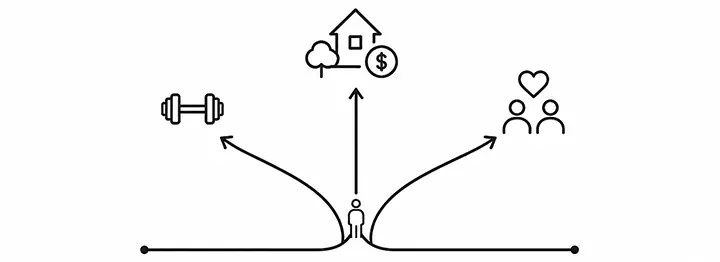
The list I arrived at is surprisingly small.
- Health.
- Wealth.
- Relationships.
There are certainly other things that matter, but most of them can be connected back to one of these categories. Physical capability and energy are tied to health. Financial security and opportunity are tied to wealth. Family, friendships, faith, and community are tied to relationships.
Why Imbalance Becomes a Problem
What I find interesting is that people rarely neglect all three.
Most people focus heavily on one.
Someone may spend years building a career while neglecting their health. Another person may become extremely focused on fitness while struggling financially. Others may dedicate themselves entirely to work and eventually realize they have very little time left for the people they care about.
The imbalance is usually not intentional. It happens because progress in one area often feels urgent while the others can be postponed.
The problem is that postponement has a cost.
Health tends to become more difficult to recover as people get older. Relationships weaken when they receive little attention. Financial problems create pressure that affects everything else. Improvements in one area do not automatically compensate for neglect in another.
Why I Limit My Goals
That observation is what led me to simplify the way I think about goals.
Instead of creating a long list of objectives every year, I prefer to identify one meaningful goal within each category.
- One goal for health.
- One goal for wealth.
- One goal for relationships.
The specific goal can change from year to year. The category remains the same.
For example, a health goal might involve reaching a target weight or completing a race. A wealth goal might involve acquiring an asset, increasing income, or reaching a savings target. A relationship goal could involve spending more intentional time with family, becoming more active in a church community, or strengthening friendships that have been neglected.
The individual goals are not important by themselves. What matters is that each major contributor receives attention.
I have found that limiting the number of primary goals creates clarity. It becomes easier to decide what deserves attention and what can wait. It also becomes easier to measure whether the year was actually productive.
Why Most Goals Are Actually Sub-Goals
Many goals that appear unrelated are often just sub-goals supporting one of the three categories.
- A business project may support a wealth objective.
- A running program may support a health objective.
- A scheduled family trip may support a relationship objective.
The categories remain stable even when the activities change.
I think this distinction is important because many people treat every objective as if it deserves equal attention.
In reality, some goals are larger than others.
For example, someone may say their goal is to increase their income, attract more clients, or start a business. Those may be worthwhile objectives, but they are often supporting something else.
- The real goal might be purchasing a property.
- The real goal might be creating financial security.
- The real goal might be building enough flexibility to spend more time with family.
The same thing happens in other areas.
A person may say their goal is to run three times per week, improve their pace, or complete a specific training program. Those are useful objectives, but they are usually supporting a larger health goal.
The actual objective may be weight loss, improved fitness, longevity, or simply maintaining the ability to stay active as they get older.
Once I started looking at goals this way, the number of things I felt responsible for became much smaller.
Instead of maintaining a long list of independent goals, I could see how many of them were connected.
- A higher income may support an asset acquisition goal.
- An asset acquisition goal may support long-term financial stability.
Also,
- A training plan may support a weight target.
- A weight target may support long-term health.
The individual activities still matter, but they make more sense when connected to something larger.
This creates clarity because it becomes easier to determine what deserves attention.
When a goal does not clearly support health, wealth, or relationships, I find myself questioning why it exists in the first place.
That does not necessarily mean it is unimportant. It simply means I want to understand what purpose it serves before investing significant time into it.
The more I think about it, the more I believe that confusion often comes from mixing goals, projects, and tasks together.
- A task is something you do.
- A project is something you build.
- A goal is something you are trying to achieve.
Treating them as the same thing makes life feel more complicated than it needs to be.
Separating them creates clarity because you can trace smaller activities back to a larger objective, and that larger objective can usually be traced back to one of the three categories.
How I Measure a Productive Year
The more I think about it, the less I believe fulfillment comes from maximizing a single area of life. It seems to come from maintaining enough progress across all of them.
Someone who is financially successful but physically unhealthy will eventually feel the limitation of that imbalance. Someone who is healthy and financially secure but isolated from meaningful relationships will experience a different type of limitation.
The categories support one another.
Financial stability can create more time for relationships. Good health creates the energy needed to pursue opportunities. Strong relationships provide support during periods when health or finances become difficult.
None of them operate independently.
That is why I keep returning to the same three areas.
Not because they guarantee happiness, but because they appear to be some of the strongest contributors to it.
When I look back on a year, I am less interested in how many goals were completed and more interested in whether these areas moved forward. If they did, the year was probably productive regardless of what else happened.
Conclusion
That level of simplicity has become useful to me. It removes a lot of unnecessary complexity and makes it easier to focus on what is likely to matter in the long run.

You may also like

Why I Train Even as a Beginner (And Plan to Keep Going)
I am still a beginner in the gym. I do not lift heavy weights, and there are…

Why I’m Building Assets Instead of Chasing Income
For a long time, I believed that the solution to most problems was simple: earn…

You Haven’t Earned the Right to Doubt Yourself Yet
Self-doubt is often treated as something natural. People question themselves,…